
Analysis of related parts of workover rig
Release time:
2020-04-24
At present, China's national economy continues to develop, which provides a broad market for petroleum and petrochemical products. The petroleum and petrochemical equipment industry, relying on China's petroleum and petrochemical industry, has experienced many years of development and has laid a solid foundation. The following isWanglian MachineryThe design of the virtual prototype of the workover rig operating platform system and the analysis of related parts are hoped to be helpful to your work.
Steam flooding high temperature non-killing well operation is an important stimulation technology in deep heavy oil recovery technology in oilfieldIt has been highly valued for oil exploitation. As an important equipment in petroleum machinery, the working condition of workover rig is more complex. In the working process, each system will produce dynamic load, making the mechanism prone to fatigue damage. In order to ensure the safety and reliability of the system, it is necessary to carry out damage estimation and life analysis on the basis of fatigue analysis theory and finite element software. In this paper, the virtual prototype simulation technology is used to establish a parametric model of the operation platform system, the pipe column pick-up system, the mechanical boom lifting system and the truss support frame, and the fatigue analysis is carried out by CAE software.
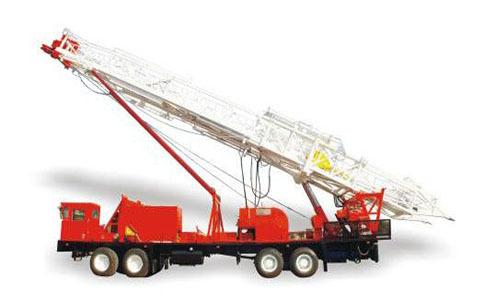
The detailed analysis scheme is as follows:
(11) Through the analysis of the actual working conditions of the operation platform, it is determined that it is affected by approximate sinusoidal load and white noise load during the working process. Combined with the classical fatigue theory, the concept of stress calculation method, stress combination method, average stress correction method and survival rate is developed in line with this analysis. The fatigue damage was analyzed by CAE software.
(2) According to the operation characteristics of the pipe string pick-up system, the mathematical model of the system is first created by the classical mechanics theory, the driving equation of the hydraulic cylinder is established, and the CAE analysis is assisted. Secondly, the rigid-flexible coupling modeling of the system is carried out, and the force and deformation of the system are obtained by transient dynamics analysis. Then, the time domain stress fatigue analysis is carried out by using the dynamic results combined with nCode, and the fatigue damage of the system is obtained to ensure the reliability. After that, the model of the clamping manipulator is established and the static analysis is carried out.
(3) In order to complete the complete set of pipe string transfer with the pick-up system, the reliability analysis of the boom lifting system is carried out. Firstly, the mathematical model of the system is established, and the characteristic curve of the system is simulated by ADAMS. Secondly, the relationship curve between the system safety factor and "stress-time" is obtained by using the Workbench and transient dynamics analysis. Then the time step stress fatigue analysis is carried out by using nCode to determine the reliability of the system.
(4) Analyze the reliability of the truss support frame, and obtain the curve of the deformation and acceleration of the beam node with the frequency change through the harmonic response analysis of the support frame. Using nCode to set random vibration excitation, the accurate vibration fatigue analysis of the support frame is carried out.
Next :
Related News
Trailer Hanging Daily How to Maintain
2023-12-09
Characteristics of drilling rig
2022-08-25
Contact Us
E-mail:admin@wanglianjt.cn
North 200 Meters West of the Intersection of Xindong Road and Gaoyang Avenue, Hualong District, Puyang City, Henan Province


SAF Coolest v1.3.1.2 设置面板 NQISD-ZDTD-JAAEE-ZQS
无数据提示
Sorry, the current column is being updated, please look forward to it!
You can view other columns or returnHome Page